Applications of Spectroscopic Methods in Chemical and Pharmaceutical Analysis: A Review
DOI:
https://doi.org/10.64062/IJPCAT.Vol2.Issue3.4Keywords:
- Microwave-Assisted Organic Synthesis (MAOS); Microwave Irradiation; Green Chemistry; Reaction Kinetics; Solvent-Free Synthesis
Abstract
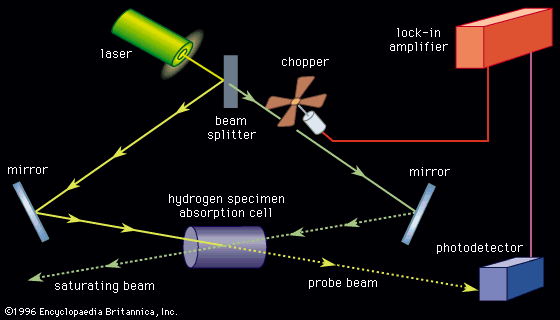
Spectroscopic techniques are some of the most vital analytical techniques in chemical and pharmaceutical sciences. The methods rest on the interaction of electromagnetic radiation with matter and are commonly used to qualitatively identify and quantitatively estimate, characterize the structure of a structure, identify impurities, and control quality. This has made them very important as they are analytical in a quick, precise, sensitive and in most cases not destructive way compared to the traditional wet chemical method. This review discusses the use of some of the common spectroscopic methods, including UV-Visible Spectroscopy, Infrared Spectroscopy, Nuclear Magnetic Resonance, Mass Spectrometry, Raman spectroscopy, fluorescence spectroscopy and atomic spectroscopy in chemical as well as pharmaceutical analysis. The review encompasses the theoretical principles, instrumentation, methodologies, applications, key findings, strengths, limitations, and future perspectives. The most important results are that spectroscopic techniques improve the accuracy of analysis, minimize time of processing, increase compliance with regulations, and aid in real-time quality control. Portable instruments, automation, chemometrics, and artificial intelligence are expected to further develop in the future.
References
Downloads
Published
Issue
Section
License
Copyright (c) 2026 This is an Open Access article distributed under the terms of the Creative Commons Attribution (CC BY NC), which permits unrestricted use, distribution, and reproduction in any medium, as long as the original authors and source are cited. No permission is required from the authors or the publishers. (https://creativecommons.org/licenses/by-nc/4.0/)

This work is licensed under a Creative Commons Attribution 4.0 International License.